For iGaming and online sports betting operators, growth rarely happens in a straight line. A major sporting event, a new market launch, a jackpot promotion, or a live betting surge can place sudden pressure on platforms that need to be fast, resilient, compliant, and always available.
That is why scaling modern iGaming platforms is no longer just an infrastructure challenge. It is an operational challenge. Operators need to keep innovating while managing more environments, more technologies, more regulatory requirements, and more demand from players who expect a seamless experience every time they log in.
The pressure behind modern iGaming platforms
Today’s operators and providers run highly distributed environments that span multiple virtualisation platforms, database engines, and deployment models – including co-location, on-premises, private cloud, public cloud, edge, and hybrid setups. At the same time, technologies such as Kubernetes, micro segmentation, automation, and distributed databases are becoming part of the standard architecture.
In practice, that means platform teams are often supporting legacy services alongside cloud-native workloads, virtual machines alongside containerised applications, and stateful databases alongside stateless services. They must also balance low-latency player journeys with unpredictable traffic patterns driven by betting events, casino promotions, and regulatory market launches.
Each layer adds capability, but each layer also adds operational responsibility. Teams need to provision infrastructure, manage upgrades, maintain security policies, monitor performance, plan capacity, validate backups, and ensure availability around the clock. As complexity grows, the skills required to manage these environments become harder to maintain and more expensive to scale.
Where operational complexity slows down momentum
Kubernetes is a strong example. It gives operators a flexible way to deploy and scale modern applications, but running Kubernetes across co-location, on-premises, cloud, and hybrid environments requires more than cluster deployment. It requires decisions around cluster and distribution design, infrastructure integration, networking, storage, control plane security, node lifecycle management, upgrades, and capacity planning.
On a scale, those responsibilities become more visible during the moments that matter most. A live betting operator may need to support sharp traffic spikes while odds are updating in real time. A casino operator may need infrastructure that can absorb a sudden surge during a promotion. A sportsbook may need to prepare for a major final where downtime is not an option. An operator entering a regulated market may need clear evidence of data residency, access controls, segmentation, and audit readiness.
In each case, the challenge is not simply whether the platform can scale. It is whether the platform can scale predictably, securely, and without pulling engineering teams away from the work that differentiates the business.
From infrastructure ownership to operational confidence
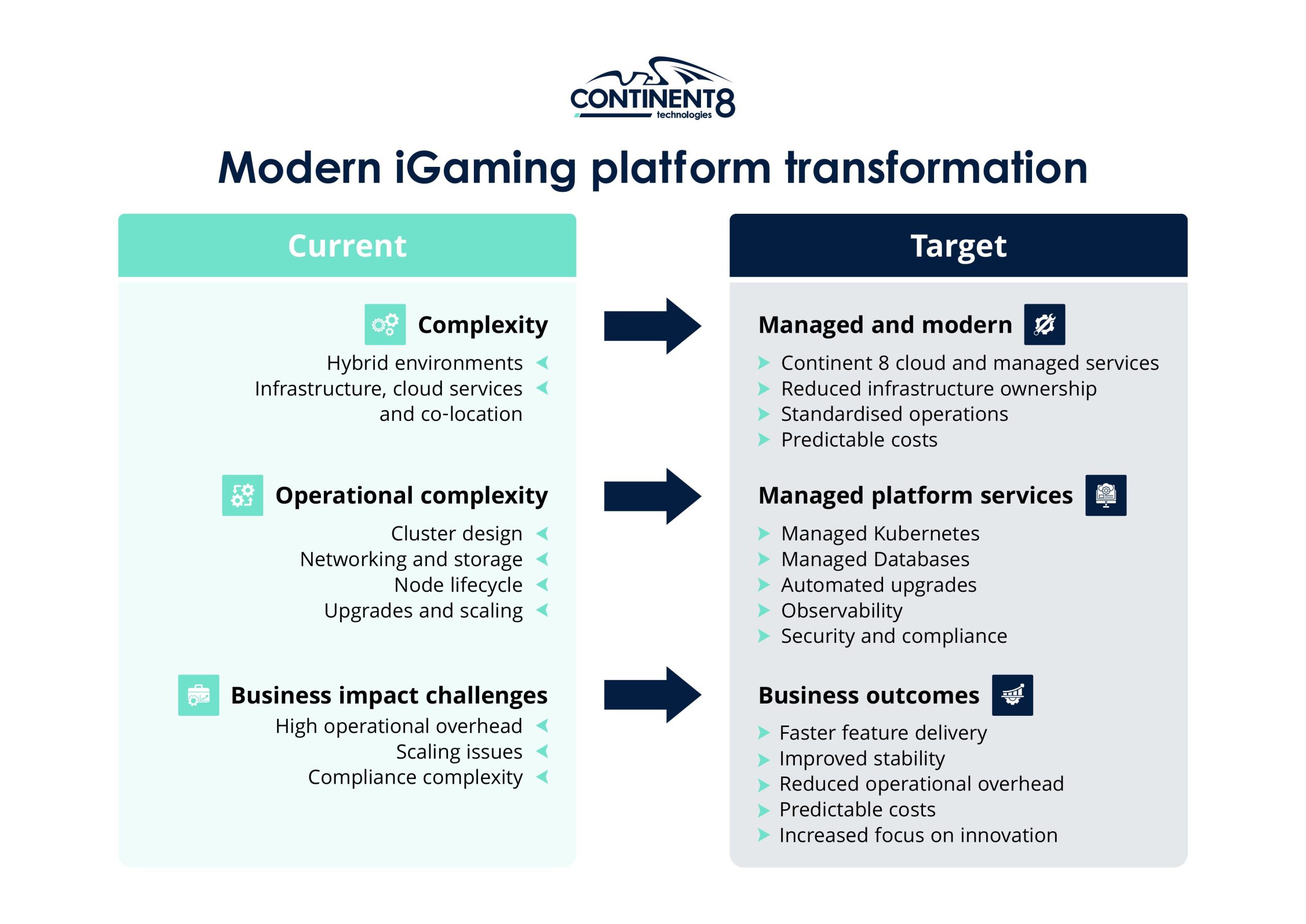
Many iGaming operators are now looking for a different model: one that reduces ownership of foundational infrastructure layers while preserving control over applications, player experience, product strategy, and data decisions.
This shift is about more than outsourcing tasks. It is about creating a consistent operating model across environments, with predictable cost models aligned to platform usage, built-in resilience and disaster recovery, standardised security and compliance controls, and clearly defined accountability between the operator and its managed services partner.
The diagram below helps illustrate this change. Instead of treating cloud, Kubernetes, databases, security, observability, backup, and day-to-day operations as disconnected workstreams, the model brings them together into a managed operating layer. That layer supports the application teams above it, helping them move faster while reducing the operational burden beneath them.
For iGaming businesses, that matters because demand is event-driven by nature. The platform may be stable on a quiet weekday, then face a sharp spike during a football final, an e-sports tournament, or a high-profile jackpot campaign. A managed operating model helps ensure capacity, resilience, monitoring, and response processes are ready before those moments arrive.
For example, our teams supported customers during the Super Bowl, helping them prepare for exceptional event-driven demand with managed services designed to maintain performance, resilience, and operational confidence when traffic and transaction volumes were at their highest.
How Continent 8 simplifies scale
Continent 8 cloud and managed services are designed for the realities of regulated iGaming and online sports betting. The aim is to help operators scale across private, multi-tenant, Kubernetes, virtual machine, AWS Outposts, hybrid, and multi-cloud environments without asking internal teams to absorb every infrastructure, networking, database, security, compliance, and operations task themselves.
In this model, Continent 8 can support the operational foundations that sit beneath the application layer, including infrastructure lifecycle management, security and network segmentation, backup and disaster recovery, observability, integration with hyperscale cloud services, and 24/7 operations.
Managed Kubernetes service
Managed Kubernetes can reduce the day-to-day effort involved in cluster provisioning, configuration, control plane and node lifecycle management, Kubernetes and operating system upgrades, availability, and scaling integration.
Managed database service
Managed database services can reduce recurring operational work around patching, version upgrades, backup validation, recovery testing, replication, failover management, and audit readiness.
The result is a more practical path to modernisation. Operators can retain control over their applications and business logic while foundational services are operated using consistent, repeatable practices designed for regulated, high-demand environments.
What this means in real iGaming scenarios
For a live betting operator, operational confidence means being ready for sudden spikes while odds, transactions, and customer interactions are moving in real time. The infrastructure must be scaled, but it must also remain observable, secure, and resilient throughout the event.
For an operator launching in a new regulated market, the pressure is different. Data residency, segmentation, logging, access controls, and audit evidence need to be considered from the start. A consistent managed model helps create repeatable foundations, so market expansion does not require a complete operational rebuild each time.
For a casino or sportsbook preparing for a major campaign, the priority is readiness. Compute capacity, database resilience, backup validation, monitoring, and incident response must all be in place before player activity peaks. Reducing the operational heavy lifting gives engineering teams more time to focus on product performance and player experience.
The value: faster, safer, and easier to operate
When infrastructure modernisation is paired with an operating model designed for scale, the value becomes more concrete. Features can move faster because teams are not waiting for every foundational task. Platforms become more resilient because lifecycle management, observability, and recovery processes are handled consistently. Compliance becomes easier to demonstrate because controls are designed into the operating model rather than added after the fact.
Costs also become easier to manage because capacity, services, and responsibilities are aligned to platform usage and business growth. Most importantly, teams gain clarity. They know what they own, what their partner operates, and how both sides work together to protect uptime, performance, compliance, and customer experience.
This focus on service quality is reflected in customer outcomes too, with a 2026 NPS score of 71 reinforcing the value of Continent 8’s managed services model that supports reliability, responsiveness, and trust.
Modern iGaming platforms do not just require modern technology. They require a smarter way to operate it – one that helps operators simplify complexity before it slows innovation, growth, or the player experience.
If you are evaluating how to scale your platform more efficiently, reduce operational overhead, or prepare for growth across regulated markets, Continent 8 can help you explore the right approach. Speak to our team at sales@continent8.com to build a more resilient, scalable, and manageable foundation for your next phase of growth.