
In cybersecurity, intelligence is power. Financial institutions and healthcare providers have long relied on threat intelligence platforms to anticipate attacks and protect critical assets. Yet, the gambling industry, despite handling billions in transactions and sensitive customer data, has been slower to adopt this proactive approach.
The stakes are high. Cyber incidents targeting gaming operators have surged dramatically, with attacks becoming more sophisticated and financially devastating. We have seen land-based casinos forced offline for days.
For an industry built on trust and real-time engagement, the question is no longer whether operators need intelligence, but how quickly they can integrate it into their security posture.
Consider financial services. Banks operate under constant threat from fraud, phishing, and ransomware, yet they’ve built robust intelligence-sharing ecosystems like FS-ISAC (Financial Services Information Sharing and Analysis Center). These platforms allow members to share threat intelligence in real time, creating collective defence that benefits the entire sector.
Gaming needs its own equivalent, but with crucial differences. Our adversaries are unique: organised crime groups targeting high-roller accounts, bonus abuse rings operating across dozens of operators, match fixers probing betting platforms, and in certain jurisdictions, nation-state actors targeting offshore operations. Generic threat intelligence platforms miss approximately 70% of gaming-specific attack patterns because they weren’t designed to recognise these threats.
Effective threat intelligence transforms security operations across several critical areas.
Smarter vulnerability management:Gaming operators run complex technology stacks spanning payment processors, gaming engines, live betting platforms, and player databases. Patching everything according to generic severity scores is impossible during live operations. Intelligence changes the equation from “how severe could this be?” to “is this being actively exploited against gaming platforms now?” When intelligence reveals a payment gateway vulnerability under active exploitation against European operators, that patch moves to the front of the queue regardless of theoretical severity.
Faster incident response:Intelligence enables teams to build playbooks for gaming-specific scenarios before incidents occur. When attacks happen, context accelerates decisions. A generic PowerShell alert becomes high priority when intelligence identifies it as a technique used by gaming-targeting ransomware groups. The MITRE ATT&CK framework provides common language for this intelligence, allowing teams to measure defensive coverage objectively and identify gaps systematically.
Example: Champions League final, an operator detected unusual API calls to their odds calculation engine. Intelligence immediately revealed the same pattern had appeared at three other sportsbooks in the preceding 48 hours. A pre-built playbook isolated affected systems automatically. The attack was contained in four minutes rather than 45.
Proactive threat hunting:Shared intelligence generates hunting hypotheses no single operator could develop alone. When multiple operators detect reconnaissance against payment systems using specific techniques, everyone can search for identical indicators. Security teams shift from reactive firefighting to actively hunting for bonus abuse automation, payment fraud patterns, and early reconnaissance.
Reduced alert fatigue:Gaming platforms generate millions of security events daily. Intelligence-driven contextualisation transforms “this IP attempted 50 logins” into “this IP is part of a credential stuffing botnet that hit six gaming sites today.” Alerts receive priority based on actual gaming industry impact. Analysts escape false positive overload and focus on genuine threats.
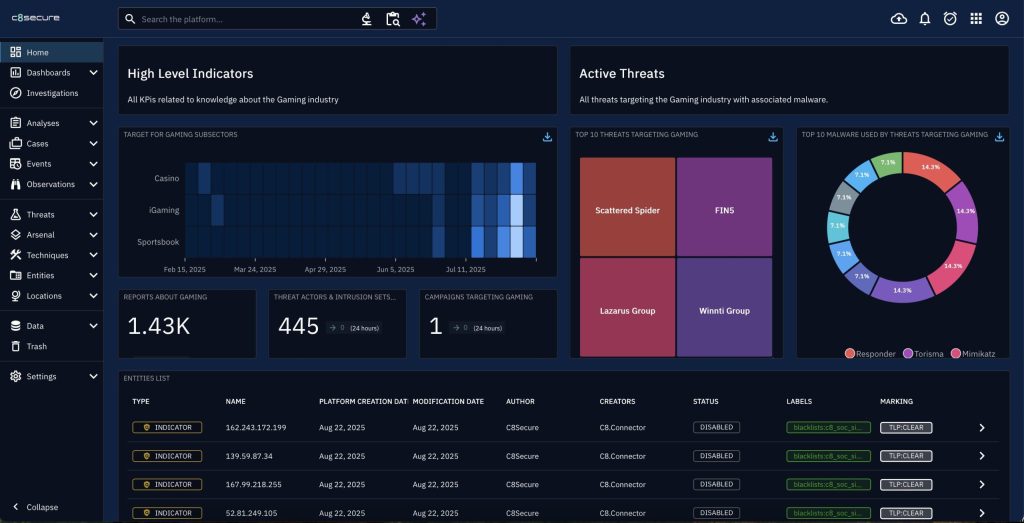
Intelligence extends beyond traditional cybersecurity. iGaming’s ecosystem of platform providers, payment processors, and affiliate networks creates significant supply chain risk. When a major provider suffers a breach, operators need immediate notification and indicators to hunt for compromise in their own environments.
Fraud prevention benefits enormously from shared intelligence. Credential stuffing, bonus abuse rings, and synthetic identity creation operate across multiple operators simultaneously. Real-time sharing allows the entire industry to block known fraudsters before they cause widespread damage.
iGaming operates under intense regulatory scrutiny across multiple jurisdictions. Intelligence programmes must account for data sovereignty when sharing across borders, maintain evidence chains for incident reporting, and demonstrate due diligence to regulators.
Rather than complicating compliance, intelligence sharing strengthens it. Documented participation demonstrates proactive security investment. Standardised incident categorisation streamlines reporting. Cross-operator intelligence identifies systemic risks that regulators will certainly notice even if individual operators miss them.
None of this works without trust. Operators compete fiercely, and sharing incident details raises legitimate concerns about competitive exposure.
Effective programmes offer anonymity where needed – operators can share indicators without identifying themselves. Clear data governance establishes who accesses what information. Critically, the value must be obvious. Operators need to see that participation makes them measurably safer, that what they receive far exceeds what they contribute. As membership grows, network effects compound: more operators sharing means better intelligence for everyone.
Gaming operations run around the clock with no maintenance windows during major sporting events. Attacks deliberately target peak revenue periods. Response times measured in hours are unacceptable.
This demands SOAR (Security Orchestration, Automation & Response) automation. When intelligence identifies malicious infrastructure, indicators must flow automatically into firewalls and detection systems. Pre-configured playbooks must execute without waiting for human intervention.
Operators with mature programmes report mean time to detect dropping from 14 hours to under 10 minutes. Mean time to respond falls from four hours to 12 minutes. False positives reduce by 70%.
With average gaming breach costs exceeding $5M including regulatory fines and customer compensation, preventing one major incident justifies significant investment. When a zero-day in payment gateway software was identified through shared intelligence, operators with access isolated vulnerable systems 48 hours before public disclosure. Those without suffer breaches averaging $5M each.
The gaming industry has reached an inflection point. We can continue operating in silos, or recognise that collective defence serves everyone’s interests. The attackers are already collaborating; we must do the same.
Financial services learned this lesson years ago. For gaming, the question is whether we learn proactively or wait for a sector-wide incident to force the conversation.
For more information on Threat Exchange, visit continent8.comor email sales@continent8.com.
**Source: EGR Digital Edition 248
As the iGaming and online sports betting industry faces increasingly sophisticated cyber threats, Continent 8 is proud to launch Threat Exchange – the sector’s first dedicated cyber threat intelligence (CTI) platform.
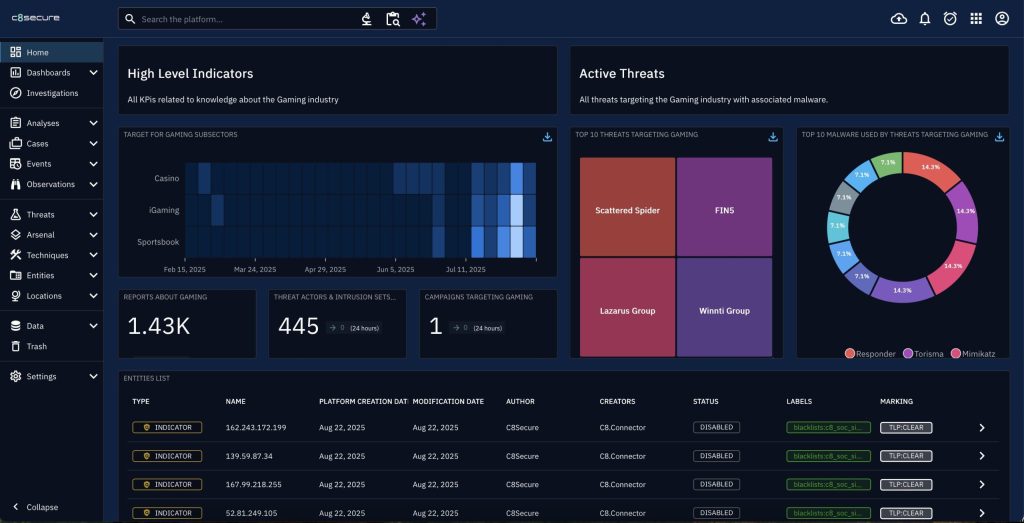
Below, we answer some of the most pressing questions regarding the solution and how it is tailored for incident response teams, operators, platform providers, B2B gaming technology companies and regulators.
A cyber threat intelligence (CTI) platform collects, analyses and shares information about current and emerging cyber threats to help organisations anticipate, detect and respond to attacks more effectively. It typically includes:
CTI platforms are essential for building a proactive security posture, especially in high-risk industries like iGaming and online sports betting.
Threat Exchange is a managed cyber threat intelligence platform designed specifically for the iGaming and online sports betting industry. It delivers real-time, sector-specific insights to help incident response teams, operators, platform providers, B2B gaming technology companies and regulators detect and share information on emerging threats, sharpen awareness and act with confidence.
Unlike generic CTI solutions, Threat Exchange is purpose-built for iGaming. It leverages Continent 8’s and C8 Secure’s unique position as both an internet service provider (ISP) and managed security service provider (MSSP) in the industry, offering exclusive intelligence, real-time threat correlation and honeypot-driven insights tailored to gaming environments.
Threat Exchange addresses the following critical challenges:
Cyber Threat Exchange’s key features include:
Whether you’re protecting high-value player accounts, monitoring threats during major sporting events or securing gaming APIs, Threat Exchange is designed to meet the needs of the industry. The solution is suitable for:
Threat Exchange offers several tiers, from a community tier with basic access to advanced tiers with predictive analytics and premium add-ons. Each tier is designed to meet different operational needs and cybersecurity maturity levels.
It’s important that businesses take a multi-layered approach to cybersecurity to ensure full protection. Add-on services include:
We’re excited for the launch but we’re already looking to the future. Developments include:
Contact your Continent 8 account manager or visit Threat Exchange to request a demo, explore pricing tiers and see how Threat Exchange can elevate your cybersecurity posture.