Two critical flaws in PHP, the programming language behind a large share of the world’s websites, were made public and fixed on 21 October 2026. Here is what they mean for your business and what to do this week.
The flaws, known as PHP2Shell, let an attacker with no username or password run their own commands on an unpatched web server. In the United States, the Cybersecurity and Infrastructure Security Agency (CISA) has told organisations to patch immediately or take affected systems offline, and in the UK the National Cyber Security Centre (NCSC) is urging organisations to act now. Continent 8 Technologies is advising every customer to treat this as a priority for the coming days.
“PHP2Shell sits in the engine underneath thousands of everyday business websites, so the question for every board this week is simple: do you know everywhere PHP runs, including at your suppliers and partners, and has each of those systems been updated? Our security teams are already working with customers to answer that question”, said Anthony Abou-Jaoude, Chief Transformation Officer, Continent 8 Technologies.
The two flaws carry the industry reference numbers CVE-2026-109618 and CVE-2026-109619. Researchers at Calif, Wiz and OpenAI found them with the help of AI tools and reported them privately to the PHP project in August. Details leaked online on 20 October, so the PHP security team released its fixes a day earlier than planned and rated both flaws 9.2 out of 10.
The weakness sits in PHP itself rather than in any single website or product. Popular systems built on PHP, including WordPress, Magento and Drupal, are exposed unless the server underneath has been updated. On the day of release, internet scanning company Censys counted more than 2.5 million servers on the internet running PHP, although not all of them will be vulnerable.
Tools to exploit the flaws are now public, and watchTowr reports attack attempts against its monitoring systems. CISA said in its alert that it had not yet seen exploitation, and as of the evening of 21 October no successful attacks had been publicly confirmed. History suggests the gap will be short: when a previous critical PHP flaw was disclosed in 2024, attackers were trying to exploit it within a day, according to Greenbone.
A web server taken over through PHP2Shell gives an attacker a foothold close to player accounts, payment journeys and back-office systems. Security firm Sansec also reports that one of the flaws can leak fragments of server memory, which may include passwords and access keys, even where no takeover happens.
For licensed operators and their suppliers, a breach quickly becomes a regulatory matter wherever they hold licences. In Great Britain, the Gambling Commission expects a security breach that affects the confidentiality of customer data, or stops customers reaching their accounts for more than 12 hours, to be reported as a key event within five working days. The Malta Gaming Authority asks for similar incidents to be reported through its Licensee Portal within 72 hours, and data protection law sets its own 72-hour deadline for personal data breaches. Businesses that handle card payments should note that PCI DSS expects critical security patches to be installed within one month of release.
In the United States, each state gaming regulator, such as New Jersey’s Division of Gaming Enforcement or the Pennsylvania Gaming Control Board, sets its own security requirements for online operators and their suppliers, so check your licence conditions for when an incident must be reported. Every state also has its own data breach notification law with its own deadlines. Companies listed on a US exchange face a further clock: under SEC rules, a cybersecurity incident judged to be material must be disclosed on Form 8-K within four business days of that judgement.
Availability is at stake as well. The NCSC, CISA and the European Union’s computer emergency response team, CERT-EU, all advise taking systems offline or isolating them if they cannot be fixed promptly. A planned maintenance window now costs far less than an unplanned outage or an incident investigation later.
Start by finding out where PHP is running. It is rarely confined to one platform. In our sector it often sits behind affiliate and comparison sites, marketing microsites built on content management systems such as WordPress, internal admin tools, older cashier pages and products bought from third parties. CISA warns that PHP is often built into other software, where it may not be obvious, and the NCSC advises checking every PHP installation, starting with anything reachable from the internet, and not assuming that only out-of-date versions are affected.
Next, update and restart. The fixed releases are PHP 8.5.12, 8.4.27, 8.3.36 and 8.2.35, and the major Linux distributions are publishing their own patched packages. Web servers must be restarted after the update, or the old code keeps running. Systems on PHP 8.1 or older no longer receive official fixes and need an upgrade or a vendor patch. Where an update cannot happen straight away, the PHP project has published temporary settings that reduce some of the risk, and a web application firewall (WAF), which filters malicious traffic before it reaches the server, can buy time. Neither replaces the update.
Then check whether anything has already happened. The NCSC recommends looking for backdoors as well as patching. In practice that means searching for web shells, which are small malicious files an attacker leaves behind to keep access, along with unexpected programs started by the web server and unexplained crashes in PHP logs. The attack can succeed without crashing anything, so a quiet system is no proof of a clean one. If a system may have been compromised, change every password and key it held.
Finally, be ready to report and bring your suppliers in. Confirm who decides whether an incident is notifiable, and make sure your compliance team has the reporting deadlines for every regulator you answer to, including gaming, data protection and, for listed companies, securities regulators. Ask every supplier and partner that runs PHP on your behalf to confirm in writing that they have patched and checked for compromise, and keep a record of their answers.
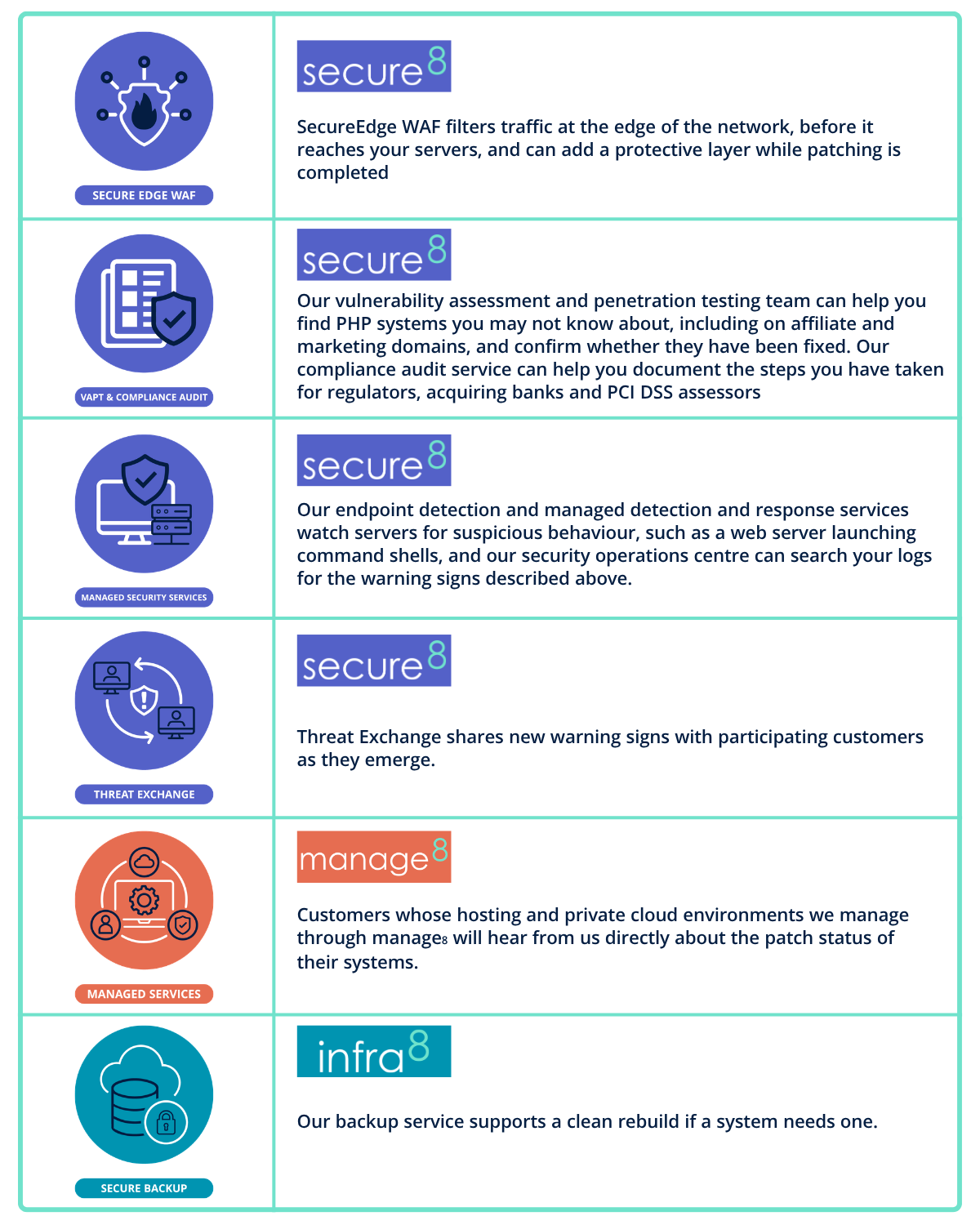
Our secure8 services can support each of those steps.
If you are unsure whether PHP2Shell affects you or your suppliers, contact your Continent 8 account manager or our security team today. If you suspect an active compromise, please get in touch so our analysts can respond as quickly as possible. We will update this advisory as the situation develops.
The gaming industry has never had more opportunities than it does today.
By Jamie Garcia, Director, Regulatory Security at Continent 8 Technologies

Every conference, every customer conversation, and every industry event seems to introduce the next big thing. Artificial intelligence. Automation. Blockchain. Digital identity. Cloud-native gaming platforms. Cashless wagering. Real-time compliance monitoring. New wagering models. The list keeps growing.
And honestly, that’s a good thing. Innovation is what keeps our industry moving forward.
But after moderating a panel at G2E on balancing innovation, regulation, and cybersecurity, I walked away with a realization that wasn’t really about AI, blockchain, or any specific technology.
The conversation kept coming back to one word: Trust.
Technology will continue to evolve. The real challenge is making sure trust evolves with it. The discussions during the panel repeatedly focused on responsible innovation, cybersecurity governance, regulatory engagement, accountability, and maintaining confidence in new technologies.
One theme that emerged consistently was that organizations are no longer debating whether technologies such as AI will have a role in gaming, but how they can be implemented responsibly within existing regulatory and operational frameworks.
Ten years ago, launching online gaming in a new market felt innovative. Today, innovation is happening across every corner of our industry.
Operators are exploring AI to improve customer support and fraud detection. Suppliers are automating processes that once required significant manual effort. Regulators are evaluating technologies that improve transparency and oversight. Organizations are finding new ways to manage identity, payments, compliance, and security.
The technology itself is rarely the difficult part. The difficult part is figuring out how to implement it responsibly. I’ve seen organizations become so focused on what a technology can do that they forget to ask what risks it introduces.
What data is being collected? Where is it stored? Who has access to it? How is it protected? How do you prove it is operating as intended?
Those are the questions that ultimately determine whether technology succeeds in a regulated environment.
Artificial intelligence was one of the hottest topics throughout G2E, and understandably so.
But what surprised me was how little the discussion centered on AI models themselves. Instead, much of the conversation focused on governance.
How do organizations ensure AI is being used appropriately? Who is accountable for the outcomes? How do you validate answers generated by AI? How do you ensure sensitive data remains protected? How do you explain decisions to regulators, auditors, and stakeholders?
Those questions are far more important than deciding which AI model to use. The model is often the easiest part. The governance is where the real work begins.
Several panelists highlighted that accountability remains one of the biggest challenges in AI adoption. While the technology continues to advance rapidly, organizations still need clear governance frameworks that define ownership, oversight, and decision-making responsibilities.
As gaming organizations continue adopting AI, success won’t be determined by who deploys AI first. It will be determined by who deploys it responsibly.
One of my favorite moments during the discussion came when the conversation shifted from technology back to people.
Because for all the excitement around AI and automation, human oversight still matters. A lot.
Technology can help us make faster decisions. It can identify patterns we might otherwise miss and it can improve efficiency and reduce manual workload.
But technology should support human decision-making, not replace it.
Gaming has always been built on integrity, accountability, and trust. Those principles don’t disappear just because we introduce new technology into the environment.
At the end of the day, accountability still belongs to people.
A mistake I still see organizations make is treating compliance and cybersecurity as final checkpoints before launch.
The product gets built. The architecture gets designed. The integrations get completed. Then someone asks if it’s compliant.
That approach almost always creates unnecessary challenges.
The most successful projects are the ones where compliance, cybersecurity, operations, and product teams are working together from the beginning.
When security and compliance are embedded into the design process, organizations can identify issues earlier, avoid costly redesigns, and launch with significantly more confidence.
That’s not slowing innovation down. That’s making innovation sustainable.
There is occasionally a narrative that innovation and regulation are somehow competing forces.
I don’t see it that way. Having worked with regulators, operators, suppliers, and technology providers across multiple jurisdictions, I’ve found that everyone is generally trying to solve the same problem.
How do we encourage innovation while maintaining integrity, consumer protection, and trust?
Those goals are not mutually exclusive.
In fact, one of the more interesting takeaways from the discussion was the level of alignment between regulators, operators, and technology providers. While perspectives naturally differed, there was broad agreement that early engagement leads to better outcomes for everyone involved.
Cybersecurity is no longer just an IT discussion.
Modern gaming environments are interconnected ecosystems.
Operators rely on cloud providers, payment processors, geolocation vendors, KYC providers, game suppliers, managed service providers, and countless additional technology partners. Every integration creates opportunity. Every integration creates risk.
Several panellists noted that as iGaming ecosystems become more interconnected, managing third-party and supply-chain risk is becoming just as important as securing internal systems and infrastructure.
That’s why cybersecurity must be considered a business requirement rather than simply a technical requirement. Security can no longer be something added immediately before certification or production deployment. It has to be built into the architecture from the start. The organizations that recognize this tend to be the ones that innovate most effectively because they avoid creating unnecessary risk along the way.
The technologies will change. AI will evolve. Blockchain use cases will mature. New products will emerge. Regulations will continue adapting. Cyber threats will continue evolving.
What will remain constant is the need for trust. Trust from regulators. Trust from players. Trust from business partners. Trust from communities.
Innovation allows the industry to grow. Regulation protects integrity. Cybersecurity protects the systems, data, and people that make innovation possible.
Those are not competing priorities. They’re interconnected responsibilities.
And when all three work together, the industry is positioned to do incredible things.
These themes were at the heart of the discussion during my G2E panel, “Balancing Innovation and Regulation in Gaming Cybersecurity,” where industry leaders explored how Gaming can continue embracing emerging technologies while maintaining strong cybersecurity, regulatory compliance, operational integrity, and public confidence.
If there was one takeaway I left the session with, it’s this:
The future of gaming won’t be defined by the technologies we adopt.
It will be defined by how responsibly we implement them.
– By Cristopher Kuehl, Chief Data, Information & AI Officer

“We have an AI strategy.”
That is now fairly standard across iGaming boardrooms. The problem? Many of those strategies are already failing at the infrastructure level.
Having a strategy and having the infrastructure required to execute it are two very different things. Across the industry, there is a growing gap between ambition and operational reality. Operators are investing in heavy large language models (LLMs) and complex predictive tools. Yet many are still relying on infrastructure originally designed for traditional workloads.
If you are an operator, the question is no longer whether a provider can “host AI”. Instead, the focus should be on how their network handles the specific, high-velocity and highly regulated demands of iGaming.
Here are the core technical questions to bring to your next vendor review.
Legacy iGaming infrastructure was built around CPUs and RAM. Modern AI requires parallel processing, graphics processing units (GPUs) and Neural Processing Units (NPUs).
If your provider is quoting standard cloud instances without detailing specialised hardware clusters, this may limit AI performance and scalability. Operators should look to providers that can offer access to high-performance GPU infrastructure within regulated environments.
Running workloads on a general-purpose cloud in a different country can create latency. Localised, high-density compute is often needed to handle real-time fraud detection and in-play personalisation.
Data residency is a strict, known regulatory requirement in iGaming and online sports betting. Player data cannot cross certain borders. However, AI creates additional complexity: not just where data is stored but where it is processed.
For example, if your player database sits in Ontario, Canada, but the AI model that is performing lives in a data centre in Virginia, US, this may raise compliance concerns depending on how data is processed and transferred. Regulators across multiple jurisdictions, including the UK and North America, are increasing scrutiny of data residency, cross-border processing and third-party dependencies.
As a result, operators should ensure that both data and the associated AI processing remain within approved regulatory boundaries. In practice, this means working with providers that support in-country or regionally compliant AI deployments.
Regulators require transparency. For example, if an algorithm flags a VIP player for problem gambling or blocks a withdrawal, the operator must be able to prove the reasons why it happened.
Standard logging alone is insufficient. You need telemetry that captures model inputs, the exact weights used, and the confidence score of the output.
Asking the provider what kind of audit logging they support at the model layer is important. Without a regulator-ready audit trail of a specific AI decision, operators cannot deploy that model in a live environment. Operators should be able to recreate the exact logic path the AI took at any historical timestamp.
In our sector, milliseconds translate directly to revenue. Research across digital platforms shows that even a one-second delay in mobile load time can reduce conversion rates by up to 20%. This highlights how sensitive user engagement is to performance, particularly in mobile-first environments that closely mirror player behaviour.
At the same time, the cost of disruption is immediate. Industry estimates suggest downtime in gaming environments can exceed $6,000 per minute, underlining the direct financial impact of even short service interruptions.
Therefore, in use cases such as real-time odds generation or live bet limits triggering, the processing time should be near zero. Operators should assess the proximity between their operational data and AI compute environments. Architectures relying on public internet connectivity may suffer in terms of user experience. A private, high-speed connection between your raw operational data and your AI models is needed, ideally with the compute sitting adjacent to the data.
Operators should evaluate orchestration and security. Scaling AI capacity based on a Saturday night player load requires managed Kubernetes specifically tuned for AI workloads. Your provider needs to scale GPU allocation up and down dynamically.
Furthermore, the security perimeter for AI is fundamentally different. Standard firewalls may not be able to stop prompt injection attacks or model manipulation.
Threat actors are no longer just trying to steal data. They are trying to disrupt the models behind the business decisions. Providers need to be able to demonstrate to operators their AI-specific defense mechanisms and how they protect the integrity of the model itself.
Stop treating AI as a plugin. It is becoming a foundational component of modern technology stacks.
The industry is moving out of the experimental phase of chatbots and into the scale phase of adoption. Even a brilliant predictive model relies on the quality of the infrastructure supporting it.
The opportunity is clear: ask better questions, demand better answers, and choose partners built for regulated AI at scale.
Before selecting an AI infrastructure provider, operators should pressure-test capabilities against a core set of non-negotiable requirements.
Continent8 has built its infrastructure specifically for the demands of regulated iGaming and online sports betting, not retrofitted from general-purpose cloud environments.
With a global footprint of licensed locations spanning over 100 data centres globally, private high-speed connectivity, and in-country compute capabilities, Continent 8 enables operators to deploy AI workloads where they need to run – securely, compliantly, and with minimal latency.
From GPU-enabled environments to fully auditable architectures and AI-aware security, the focus is on delivering infrastructure that is aligned to the operational realities of modern iGaming. As AI moves into core production systems, having a provider that understands both the regulatory landscape and the performance requirements becomes essential.
To see how leading operators are deploying AI securely, compliantly and at scale using purpose-built infrastructure, explore iGaming Business’ latest industry report: What operators should be asking their AI solution providers in 2026
— By Craig Lusher, Principal Solutions Architect at Continent 8 Technologies
This blog looks at why security investment so often stalls, and how Continent 8 Technologies’ new Loyalty+ programme is designed to give eligible customers a clearer route to strengthening their cyber resilience.

Most organisations already know their security could be better. Far fewer have an obvious route to getting there.
That gap is rarely about awareness. In iGaming and online sports betting, security sits on board agendas, in supplier contracts and under regulatory scrutiny. The difficulty is more practical. Security work competes for budget against everything else a business needs to fund, and the case for spending money on a problem that has not happened yet is always harder to make than the case for spending it on one that has.
The evidence has not made that argument any easier to win. Verizon’s 2026 Data Breach Investigations Report analysed more than 31,000 security incidents and over 22,000 confirmed breaches across 145 countries. It found third parties involved in 48% of breaches, a 60% rise year on year, and recorded exploitation of vulnerabilities overtaking stolen credentials as the most common way into an organisation for the first time in 19 years, accounting for 31% of breaches against 13% for credentials. Remediation is not keeping pace: only 26% of the vulnerabilities in CISA’s Known Exploited Vulnerabilities catalogue were fully patched during 2025, with a median remediation time of 43 days.
The cost when something does go wrong has climbed as well. IBM’s 2026 Cost of a Data Breach Report puts the global average at $4.99 million, up 12% on the previous year. More than a quarter of organisations hit by a malicious attack said it was AI-driven, and those incidents added around $1 million each to the total. Downtime carries a separate bill. ITIC’s research into the hourly cost of downtime found that more than 90% of mid-size and large enterprises lose over $300,000 for every hour of outage, with 41% putting their exposure between $1 million and more than $5 million an hour.
For a sector built on interconnected platforms, specialist suppliers and always-on services, the third-party and downtime figures tend to be the ones that land hardest.
In practice, security spend is often triggered by something external. A regulator asks a question, a customer sends a security questionnaire, a penetration test result lands, or an incident forces the issue. Each of those produces a purchase, but not necessarily a plan.
The result is familiar. Controls accumulate one at a time, chosen to answer whichever question was being asked at the time, and the joins between them are rarely revisited. Meanwhile the work that has no immediate trigger, such as testing an application nobody has looked at for two years, running a phishing simulation, or checking whether your brand is being spoofed somewhere, keeps sliding down the list because nothing is forcing it up.
None of this reflects badly on the teams involved. It reflects how budgets work. Money that is already committed to infrastructure is easier to defend than money that has to be found for something optional.
Loyalty+ is Continent 8’s new security credits programme. Eligible contracts are automatically enrolled in the Loyalty+ programme, enabling customers to earn security credits worth 5% of the Total Contract Value (TCV) of invoiced Continent 8 spend. These credits can then be redeemed against our qualifying cybersecurity services.
One credit is worth one US dollar when it is redeemed, so there is no conversion to work out and no ambiguity about what a balance is worth. There is nothing to buy and no sign-up process. If you have new invoiced spend with us, you earn credits automatically under the programme terms.
For contracts of twelve months or longer, the credits for the whole term are granted when you sign, rather than trickling in month by month. A customer on $20,000 a month across cloud and colocation, signing a 24-month term, has 24,000 credits available from day one, worth $24,000 against security services.
The practical effect is that the security work which normally waits for a trigger already has funding attached to it before the trigger arrives.
Credits can only be redeemed against Continent 8 security services, within that, the choice is entirely yours. If you already have a supplier for penetration testing, direct your balance somewhere else. If you want to trial a service before committing budget to it, credits let you do that without a business case.
The catalogue covers two broad groups: one-time engagements, such as VAPTs and Audits and ongoing solutions, such as MSOC (Managed Security Operations Centre), EDR and MDR services, Threat Exchange, the SafeBait platform and dark web monitoring.
You can pay part in credits and part in cash, so a balance that does not quite cover a piece of work is still useful. The minimum redemption is 250 credits. Subscriptions funded with credits carry a minimum twelve-month commitment, and continue at the standard rate afterwards unless you cancel. Your Account Manager holds the current credit price of each service and can arrange redemptions, though some engagements, penetration testing in particular, need scheduling and take a few weeks to organise.
Credits expire twelve months after they are granted. When you redeem, the oldest credits in your balance are used first, so your more recent credits keep their full validity. We aim to remind you around 60 days and again around 30 days before anything is due to expire.
When you renew a contract, you receive a fresh allocation for the new term, any unused credits carry over, and the expiry clock resets from the renewal date. If you end all of your Continent 8 services, you have 90 days from your final service ending to redeem what remains.
Credits have no cash value. They cannot be exchanged for money or account credit, transferred to another customer, applied to non-security services, or refunded. The programme is offered at our discretion and the full terms are available from your Account Manager.
We should also say what Loyalty+ is not. It does not make an organisation secure, and no programme of this kind could. It funds work that we think is worth doing, and the value of that work depends entirely on what you choose to do with the findings.
The version launching now is deliberately simple. Every customer earns at the same 5% rate, and the mechanics are kept easy to explain.
Continent 8 has been protecting the iGaming and online sports betting industry for decades. In a sector where one organisation’s exposure can reach across connected platforms, suppliers and players, we have a direct interest in the security maturity of the businesses we work with, not only our own. Loyalty+ is one attempt to act on that.
For eligible Continent 8 customers, it turns spend you have already committed into security work you might otherwise have deferred. To find out what your balance could be, speak to your Account Manager or visit https://www.continent8.com/loyalty. T&Cs apply https://www.continent8.com/loyalty-tc/.
In the iGaming industry, cybersecurity is not just about protection – it’s about uptime, regulatory compliance, and player trust.
Vulnerability Assessment and Penetration Testing (VAPT) plays a critical role in achieving those outcomes. Yet too often, the service operators and suppliers receive fails to deliver meaningful value.
Across the iGaming industry, we consistently hear the same frustrations. These aren’t minor issues – they represent gaps that can directly impact resilience, compliance, and revenue.
Here are the eight most common complaints – and what iGaming organisations should really expect instead.
This is one of the biggest challenges. Many VAPT reports focus heavily on technical scoring systems without explaining what the findings actually mean in an operational context.
The reality is that iGaming organisations need to understand how vulnerabilities affect player data, wallet integrity, and platform availability – not just their severity rating.
At Continent 8, we frame every finding in terms of real-world impact, linking vulnerabilities directly to risks such as player account compromise, payment exposure, or downtime during peak events – ensuring both technical and non-technical stakeholders can take action.
A long list of issues without clear direction often creates more confusion than clarity – particularly in complex, high-availability environments.
The reality is that operators need practical, prioritised guidance that can be implemented without introducing risk or disrupting services.
That’s why our approach focuses on:
Too many VAPT engagements are carried out purely to tick a regulatory box, resulting in limited depth and minimal real-world value.
The reality is that attackers don’t work to compliance frameworks – they exploit weaknesses in real time.
That’s why we take a threat-led approach, focusing on:
We help customers move beyond compliance towards genuine resilience.
In iGaming, downtime isn’t just inconvenient – it directly impacts revenue and player trust, especially during major sporting events. We calculate that the average cost per minute for an operator during downing is $6K!
The reality is that security testing must work around operational priorities, not against them.
That’s why our engagements are designed to:
Security should strengthen availability – not risk it.
A lack of communication during VAPT engagements often leaves organisations uncertain about progress, findings, and potential risks. The reality is that testing should be a collaborative process, particularly in regulated environments where transparency matters.
Our approach ensures:
This gives customers greater visibility – and faster resolution of critical issues.
Fixing vulnerabilities is only part of the process. Without validation, organisations can’t be confident the risk has been fully addressed – or demonstrate that to regulators.
The reality is that verification is essential for both security assurance and compliance.
That’s why we include:
iGaming environments are highly specialised, with complex integrations across platforms, wallets, APIs, and multi-jurisdiction infrastructure.
The reality is that generic testing approaches often miss the most critical risks.
At Continent 8, our deep experience (28+ years) in the sector means we understand:
This allows us to deliver relevant, targeted testing aligned to real-world environments.
Many organisations still rely on periodic testing, despite operating in a landscape where platforms and threats evolve continuously.
The reality is that a once-a-year test cannot provide meaningful assurance in a dynamic iGaming ecosystem. You need a long-term partner, not a one-off vendor.
That’s why we position VAPT as part of a continuous security lifecycle, including:
In iGaming, the stakes are uniquely high. Security failures don’t just create risk – they can impact revenue, compliance, and player trust in real time.
VAPT should not be treated as a standalone exercise, but as a strategic capability that evolves alongside your platform.
At Continent 8, we’ve built our approach around what iGaming organisations actually need:
Because in iGaming, it’s not just about identifying vulnerabilities – it’s about ensuring your platform remains secure, resilient, and always available.
And we’re proud to be trusted by some of the biggest names in the industry, including: TheScore, NeoGames, Hard Rock, ODDSworks and more.
Thinking of switching providers? Experience a better standard of VAPT – without the switching risk.
If you’re considering replacing your current provider, we offer 25% off your first VAPT engagement* (based on our standard pricing), so you can properly evaluate a more effective approach. Learn more here
*T&Cs apply
Our Chief Transformation Officer, Anthony Abou-Jaoude, comments on how AI signals a shift towards faster, more autonomous cyber capability – and why iGaming companies must respond with greater resilience and visibility.

Artificial Intelligence (AI) is evolving at an unprecedented pace, transforming both how cyber criminals operate and how organisations defend themselves. As AI models become more capable, the speed of vulnerability discovery, reconnaissance, phishing and attack preparation is increasing, changing the economics of cyber attacks and reducing the time defenders have to respond.
Recent developments such as Anthropic’s Claude Mythos, alongside a wider wave of AI-driven cybersecurity initiatives, have highlighted just how quickly these capabilities are progressing. But while individual models may dominate the headlines, they are part of a much broader trend: AI is moving beyond content generation and into increasingly sophisticated security research and automation.
For iGaming operators, this shift is particularly important. The industry relies on always-on platforms, complex third-party ecosystems and high levels of customer trust. As AI accelerates the ability to identify and exploit weaknesses, operators face greater pressure to reduce exposure, improve visibility and strengthen resilience across their environments.
From our perspective working with the iGaming sector, the key change is not just the technology itself, but how quickly it is compressing the time between identifying weaknesses and exploiting them in live environments.
Recent analysis from Bain and the UK AI Security Institute points in the same direction: AI-enabled cyber capability is accelerating, requiring organisations to adopt more proactive, continuously monitored and resilient security models.
Industry data reinforces the urgency. Verizon’s 2025 Data Breach Investigations Report found that credential abuse remained the leading initial access vector in breaches at 22%, while vulnerability exploitation rose to 20%. Human involvement remained present in 60% of breaches and third-party involvement doubled to 30%. For operators managing high-value platforms and multiple suppliers, these risks are already business-critical.
Recent incidents in the iGaming supply chain have also shown how weaknesses at third-party providers can translate directly into financial and operational impact, including cases where compromised systems enabled exploitation of game mechanics and payouts.
The message is clear: as AI continues to reshape the threat landscape, organisations can no longer rely on traditional security approaches alone.
Here are eight priorities every iGaming organisation should focus on today.
The window between a vulnerability being disclosed and exploited is shrinking rapidly.
Continuous vulnerability assessments, penetration testing and efficient patch management are critical to identifying and remediating weaknesses before attackers can take advantage of them. In reality, we are already seeing shorter windows between vulnerability disclosure and exploitation, particularly across cloud infrastructure and third-party integrations. This is where the Claude Mythos story becomes relevant in practical terms: as AI improves vulnerability discovery, the time organisations have to assess exposure and remediate weaknesses will continue to shrink.
External commentary has gone as far as describing an approaching flood of machine-speed findings and a collapse in the window between discovery and weaponisation. Verizon’s 2025 DBIR also reported that exploitation of vulnerabilities as an initial access step grew by 34% year over year, while only around 54% of perimeter device vulnerabilities were fully remediated, with a median remediation time of 32 days. Organisations that can reduce that exposure window will be significantly better positioned to defend against AI-enhanced attacks.
Cyber resilience starts with understanding where your biggest risks lie.
Infrastructure assessments, architecture reviews and security consulting help organisations identify hidden dependencies, misconfigurations and operational weaknesses before they become business-critical incidents. In an industry where availability is essential, resilient design is just as important as strong perimeter security. This is also where zero trust principles, segmentation and the elimination of avoidable single points of failure become increasingly important as AI compresses the time attackers need to probe and exploit weaknesses.
Threat actors don’t work to business hours, and neither should your security operations.
Continuous monitoring through a modern managed Security Operations Centre (SOC), supported by SIEM, EDR and MDR capabilities, enables organisations to detect suspicious activity quickly, investigate incidents efficiently and respond before they become major business disruptions. This matters even more during high-pressure periods we’re seeing, such as major sporting events, promotional campaigns and holiday traffic peaks, when availability is business-critical and attackers know disruption has greater leverage.
Our data reports have repeatedly shown that DDoS activity intensifies around high-profile events and high-demand periods such as Christmas, especially in sectors where uptime directly affects revenue and customer trust. In this sense, the future of iGaming security depends not only on prevention, but on maintaining continuous visibility when attack conditions are most favourable.
The earlier threats are identified, the more options defenders have to contain them.
As AI makes phishing attacks more convincing, stolen credentials remain one of the simplest ways for attackers to gain access to critical systems.
Multi-factor authentication (MFA), privileged access management and least-privilege policies continue to be among the most effective controls iGaming operators can implement. In today’s threat landscape, identity has become the new security perimeter. That is particularly relevant in iGaming, where account takeover, credential stuffing and promotional abuse are well-recognised attack paths. Recent cyber incidents at large casino and betting operators have also stemmed from compromised employee accounts, reinforcing how credential-based attacks remain a critical risk even in mature environments and why stronger authentication and tighter access controls are essential.
Across the environments we manage, credential-based attacks remain one of the most consistent and effective entry points for attackers.
Modern gaming environments span cloud infrastructure, private networks, edge locations and multiple third-party providers.
Without comprehensive visibility, security teams risk missing early indicators of compromise.
Centralised monitoring, security analytics and unified visibility enable organisations to identify risks faster, prioritise investigations more effectively and maintain stronger operational resilience across increasingly complex environments. As organisations adopt more AI tools internally, visibility also needs to extend to how those tools are being used, what data they can access and where governance controls may be lacking.
As AI enhances phishing sophistication and enables more convincing impersonation attempts, stolen credentials remain one of the simplest ways for attackers to gain access to critical systems. We are seeing phishing campaigns that are increasingly difficult for users to distinguish from legitimate communications, even in well-trained organisations, further increasing the importance of continuous awareness.
According to ENISA’s 2025 Threat Landscape report, phishing accounts for around 60% of all initial intrusion attempts, and over 80% of social engineering campaigns now use AI-generated content. In response, multi-factor authentication (MFA), privileged access management, and least-privilege policies continue to be among the most effective controls iGaming companies can implement. Regular phishing simulations and security awareness training help reinforce these controls. In today’s threat landscape, identity has become the new security perimeter.
No organisation can expect to prevent every cyber attack.
What separates resilient organisations is how effectively they respond when an incident occurs.
Well-defined incident response plans, regular tabletop exercises, threat intelligence sharing and clearly established communication processes help minimise disruption, accelerate recovery and protect customer trust when every minute counts. In an AI-driven threat landscape, resilience depends on being able to make faster decisions under pressure, contain attacks earlier and recover services without prolonged operational impact.
While AI is helping attackers become more sophisticated, it is also transforming cyber defence.
AI-powered security operations can analyse vast volumes of telemetry, identify behavioural anomalies, prioritise alerts and accelerate investigations faster than traditional manual processes alone. That is the constructive side of the Claude Mythos conversation. The headline may be about what advanced models could enable, but the real opportunity for operators lies in applying AI carefully and defensibly within security operations to improve visibility, triage and response. In the years ahead, cybersecurity will increasingly become an AI-vs-AI challenge, with organisations needing trusted human oversight, strong governance and resilient operating models alongside automation.
By combining AI with experienced security professionals, organisations can improve detection, reduce response times and strengthen their overall security posture in an increasingly complex threat landscape.
Looking beyond today’s headlines
Claude Mythos may be one of the latest headlines, but it is only one example of a much broader shift. AI is changing the speed, scale and sophistication of cyber activity across the board, creating both new opportunities for defenders and new advantages for attackers. For the iGaming industry, the question is not whether AI will reshape the threat landscape, but whether organisations are prepared to adapt as quickly as it evolves.
The companies best placed to succeed will be those that translate this shift into practical action: shorter patch cycles, stronger identity controls, better visibility across hybrid environments, continuous monitoring, more mature incident response and ongoing workforce awareness. In other words, the same eight priorities outlined here become even more important as AI raises the pace of attack and defence alike.
The future of iGaming security will not be defined by a single tool or model. It will belong to organisations that continuously adapt by reducing vulnerabilities, strengthening infrastructure, improving visibility, investing in their people and embracing AI as part of a proactive cybersecurity strategy grounded in real operational risk.
At Continent 8, we believe cybersecurity is no longer just about protecting technology. It is about protecting business continuity, player trust and long-term growth across the iGaming industry. That is why operators are increasingly looking for joined-up support across areas such as vulnerability assessment and penetration testing, managed SOC and SIEM, EDR and MDR, phishing simulation, identity security and MFA, rather than relying on isolated point solutions.
As AI continues to redefine the threat landscape, companies that invest in resilience today will be better positioned to stay ahead of tomorrow’s threats. For the iGaming sector, that means combining strong cyber fundamentals with continuous monitoring, informed governance and practical use of AI in cyber defence. To learn how Continent 8 supports always-on environments with layered cybersecurity services, speak to our team at sales@continent8.com.
In an exclusive Q&A with NEXT.io, Continent 8 Technologies CEO Mike Small discusses his transition into the role, succeeding founder Michael Tobin, the impact of AI on the technology sector, and the strategic priorities shaping the company’s next phase of growth.

NEXT: After serving as a strategic board advisor over the last year, what ultimately convinced you to take on the CEO role at Continent 8 Technologies?
Mike Small: Having worked alongside the leadership team over the past year, I gained a real appreciation for what makes Continent 8 special. The company has built an outstanding reputation as a trusted technology partner to many of the world’s leading iGaming operators and platform providers, and that reputation has been earned through a relentless focus on customer success, innovation and operational excellence. Our Net Promoter Score of 71 is a great reflection of the trust our customers place in us and the commitment of our teams to delivering exceptional outcomes.
What ultimately convinced me was the combination of a strong foundation and the opportunity ahead. The business has exceptional people, deep customer relationships and market-leading technology, but I also see tremendous potential for growth as the industry continues to evolve and embrace new technologies, including AI.
Joining as CEO was an opportunity to help shape the next chapter of an already successful story.
NEXT: Looking back on your first months engaging with the business, what stands out most about Continent 8’s culture, people and customer relationships?
MS: The first thing that stood out to me was the calibre of the people. Across every part of the organisation and every location, I encountered teams that are passionate about what they do and genuinely committed to delivering for customers.
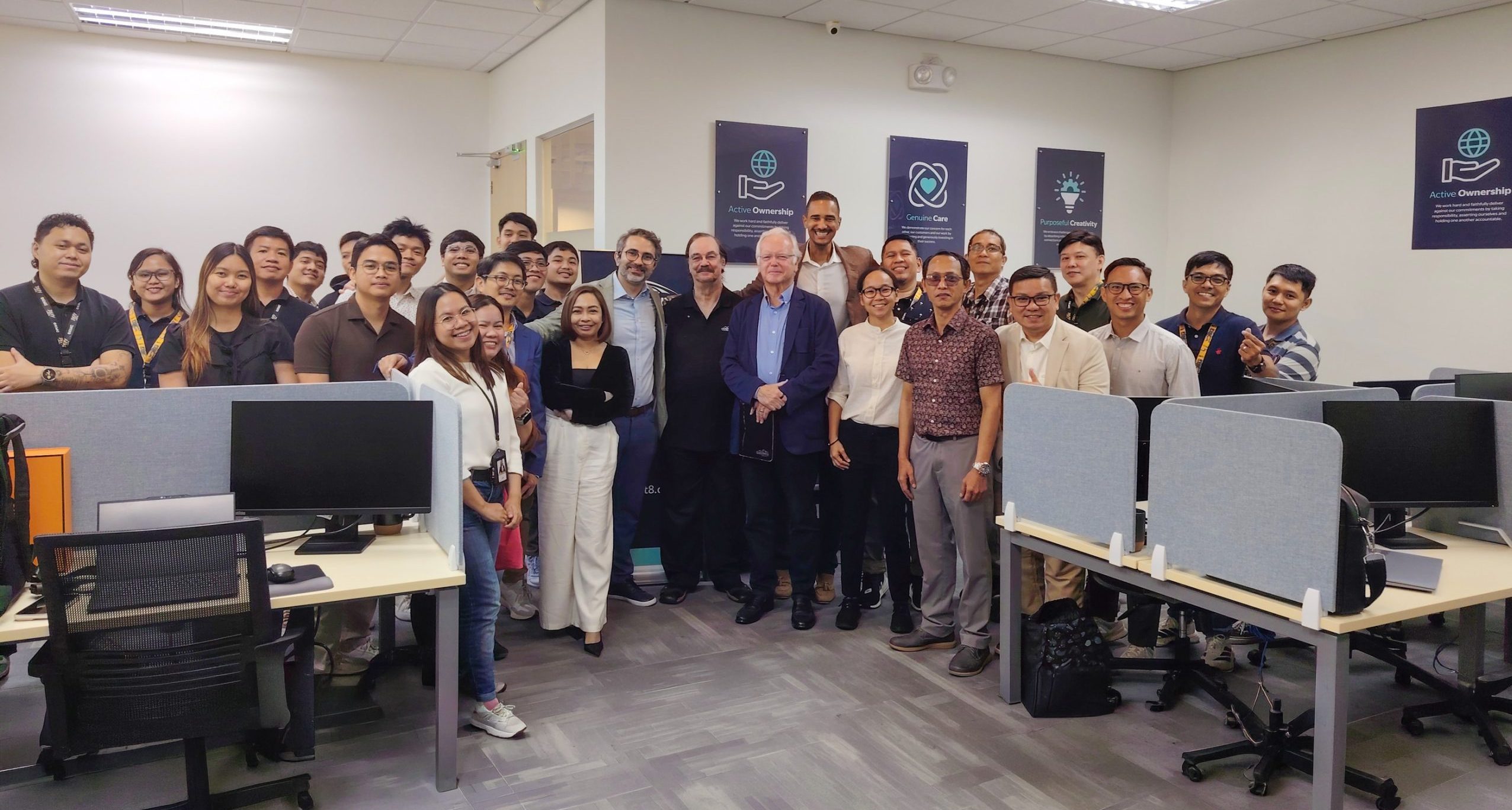
A key part of my work as strategic board advisor was helping shape the future operating model of the business, drawing on my experience building and scaling global delivery organisations. One of the achievements I’m particularly proud of is strengthening our Global Capability Centre strategy across India, the Philippines and Bulgaria. These centres play an important role in supporting our customers around the world, while enhancing our ability to scale, innovate and access exceptional talent.

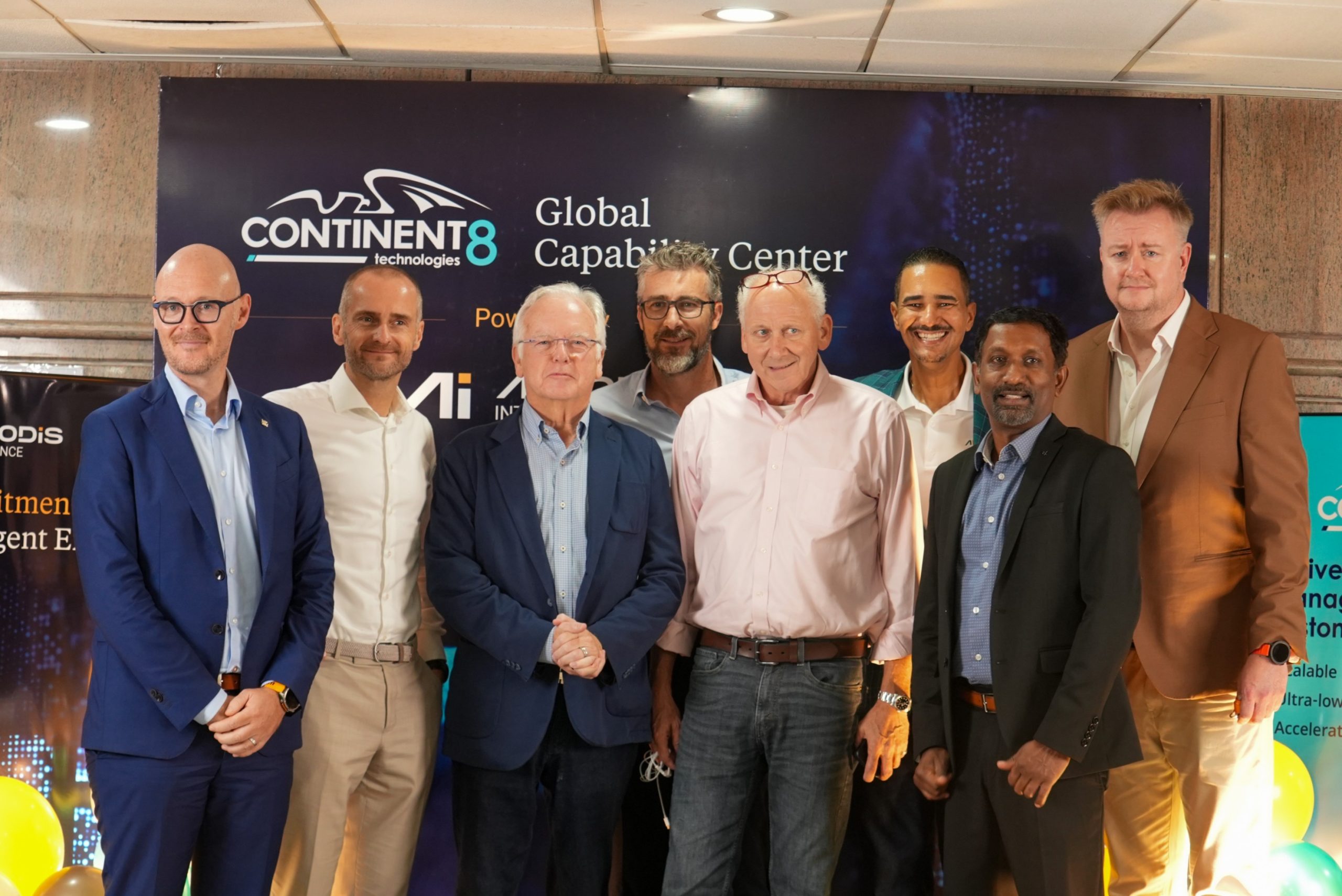
I was also impressed by the strength of the relationships Continent 8 has built across the industry, not only with customers but also with strategic partners (the likes of AWS and Nutanix). Technology is obviously at the heart of our business, but it’s the trust we’ve established over many years that truly differentiates us.
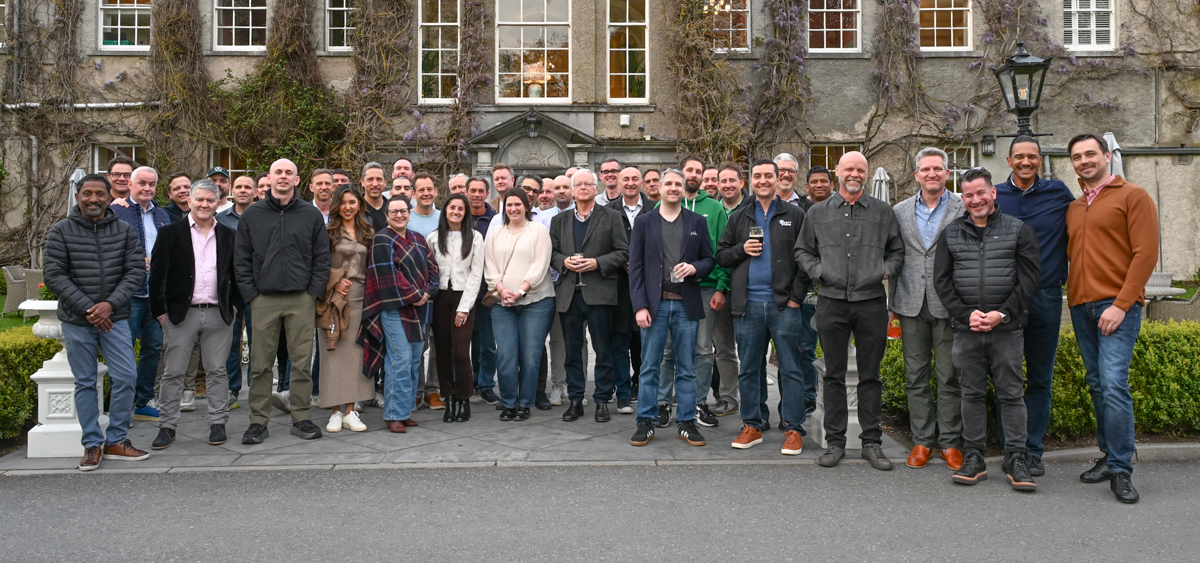
Attending my first Continent 8 Customer Advisory Board meeting brought that to life. Hearing directly from customers about the value they place on our partnership, and seeing the openness of those conversations, reinforced just how strong those relationships are.
NEXT: Michael Tobin founded the business nearly three decades ago and has become one of the most recognisable figures in gaming technology. What conversations did you have with him ahead of taking the role, and how do you balance preserving what has made Continent 8 successful while bringing your own leadership approach?
MS: Michael has built an incredible business over the past 28 years, and one of the things that struck me most during our conversations was his passion for the company, our people and our customers. His leadership has shaped not only Continent 8’s success, but also the culture and values that define the business today. The respect he has earned across the industry reflects that legacy.
The transition has been carefully planned and there is a shared understanding that success comes from building on the foundations that have already been established. My focus is not on changing what has made Continent 8 successful. It’s about helping the company evolve, identifying new opportunities and ensuring we’re positioned for long-term growth.
Michael remains closely involved as chairman, which provides valuable continuity, while I bring my own experience from leading global technology organisations and scaling businesses through periods of transformation and growth. Together, that creates a strong platform for the future.
NEXT: You bring experience from organisations including Akkodis, Adecco, IBM, Hewlett Packard and Capgemini. Which lessons from those roles will be most valuable in this next chapter?
MS: I’ve been fortunate to work across a variety of global technology and services businesses, and while every organisation is different, some lessons are universal.
The most important is staying close to your customers. Technology evolves rapidly, but organisations that truly understand their customers’ challenges are best positioned to create value. Throughout my career, the most successful businesses I’ve seen are those that listen carefully, anticipate change and remain focused on solving real customer problems.
Additionally, I’ve seen firsthand the importance of balancing innovation with execution. It’s one thing to have a vision for where the market is headed; it’s another to consistently deliver for customers every day. The most successful organisations are those that can do both.
Those principles will continue to guide my approach at Continent 8 as we focus on supporting our customers, developing our people and driving the next phase of growth.
NEXT: Continent 8 has grown from a single data centre business into a global technology provider operating more than 100 connected locations worldwide. What do you believe has been the key to that success, and what opportunities excite you most about the next stage of growth?
MS: The company’s success has been built on consistently listening to customers and evolving alongside their needs. As the industry has grown and become increasingly global, regulated and technology-driven, Continent 8 has continued to invest in the infrastructure, expertise and services required to support that evolution.
A key part of that success has been our global network of 100+ locations, which today is recognised as one of the top 20 most connected networks in the world. It is the bedrock of our business and the foundation on which we have built our broader portfolio of infrastructure, cloud, cybersecurity and managed technology services. Our customers operate in environments where performance, resilience and connectivity are critical, and that network gives them the platform they need to scale with confidence.
What excites me most is that we’re still at the beginning of some very significant opportunities. New regulated markets continue to emerge, customer environments are becoming more complex, and organisations are increasingly looking to modernise their technology estates through cloud adoption, data-driven decision making and AI-enabled innovation. At the same time, demand for secure, resilient and high-performance technology solutions continues to increase.
As these trends accelerate, customers need partners that can help them navigate change with confidence. With 28 years of experience in the highly regulated iGaming industry, Continent 8 combines deep sector expertise with a global technology platform spanning infrastructure, cloud, cybersecurity and managed services.
That puts us in a unique position to help customers modernise their environments, leverage emerging technologies such as AI, and expand into new markets, all while maintaining the security, performance and compliance that are critical to their success.
NEXT: Artificial intelligence is becoming a major focus across every industry. Having helped shape AI strategy in previous leadership roles, where do you see the biggest opportunities for AI within Continent 8 and across the wider gaming ecosystem?
MS: AI has enormous potential, but I believe the iGaming industry is still in the early stages of understanding how transformative it can be. During my time at Akkodis, I saw firsthand how AI can move beyond theory and deliver real business value, helping organisations accelerate innovation, improve productivity, optimise operations and make smarter decisions at scale.
Across the gaming ecosystem, AI will help operators become more efficient, make better use of data and improve decision-making. It also has significant potential to strengthen cybersecurity capabilities, automate repetitive processes, enhance operational performance and improve the overall customer experience.
Within Continent 8, we’re focused on how AI can help us deliver even greater value to customers. That includes improving operational efficiency, enhancing service delivery and creating smarter, more resilient technology environments. We also see significant opportunities to leverage AI across our global infrastructure and cybersecurity capabilities, helping customers identify risks faster, respond more effectively to player queries and optimise their operations.
NEXT: Finally, when you reflect on your tenure several years from now, what would success look like to you?
MS: Success starts with our customers. If we continue helping customers achieve their goals and strengthen our position as a trusted long-term partner, that will be a significant measure of success.
Equally important is creating an environment where our people can thrive and develop. Great organisations are built by great teams, and I’m committed to ensuring Continent 8 remains a place where talent, innovation and collaboration flourish.
Ultimately, I would like to look back and see a business that has continued to grow, continued to innovate and continued to build on the remarkable legacy that Michael and the team have created, while positioning itself for even greater success in the years ahead.
We have an exceptional foundation, a world-class team and a tremendous opportunity ahead of us. I’m incredibly excited about the future of Continent 8.
For iGaming and online sports betting operators, growth rarely happens in a straight line. A major sporting event, a new market launch, a jackpot promotion, or a live betting surge can place sudden pressure on platforms that need to be fast, resilient, compliant, and always available.
That is why scaling modern iGaming platforms is no longer just an infrastructure challenge. It is an operational challenge. Operators need to keep innovating while managing more environments, more technologies, more regulatory requirements, and more demand from players who expect a seamless experience every time they log in.
Today’s operators and providers run highly distributed environments that span multiple virtualisation platforms, database engines, and deployment models – including co-location, on-premises, private cloud, public cloud, edge, and hybrid setups. At the same time, technologies such as Kubernetes, micro segmentation, automation, and distributed databases are becoming part of the standard architecture.
In practice, that means platform teams are often supporting legacy services alongside cloud-native workloads, virtual machines alongside containerised applications, and stateful databases alongside stateless services. They must also balance low-latency player journeys with unpredictable traffic patterns driven by betting events, casino promotions, and regulatory market launches.
Each layer adds capability, but each layer also adds operational responsibility. Teams need to provision infrastructure, manage upgrades, maintain security policies, monitor performance, plan capacity, validate backups, and ensure availability around the clock. As complexity grows, the skills required to manage these environments become harder to maintain and more expensive to scale.
Kubernetes is a strong example. It gives operators a flexible way to deploy and scale modern applications, but running Kubernetes across co-location, on-premises, cloud, and hybrid environments requires more than cluster deployment. It requires decisions around cluster and distribution design, infrastructure integration, networking, storage, control plane security, node lifecycle management, upgrades, and capacity planning.
On a scale, those responsibilities become more visible during the moments that matter most. A live betting operator may need to support sharp traffic spikes while odds are updating in real time. A casino operator may need infrastructure that can absorb a sudden surge during a promotion. A sportsbook may need to prepare for a major final where downtime is not an option. An operator entering a regulated market may need clear evidence of data residency, access controls, segmentation, and audit readiness.
In each case, the challenge is not simply whether the platform can scale. It is whether the platform can scale predictably, securely, and without pulling engineering teams away from the work that differentiates the business.
Many iGaming operators are now looking for a different model: one that reduces ownership of foundational infrastructure layers while preserving control over applications, player experience, product strategy, and data decisions.
This shift is about more than outsourcing tasks. It is about creating a consistent operating model across environments, with predictable cost models aligned to platform usage, built-in resilience and disaster recovery, standardised security and compliance controls, and clearly defined accountability between the operator and its managed services partner.
The diagram below helps illustrate this change. Instead of treating cloud, Kubernetes, databases, security, observability, backup, and day-to-day operations as disconnected workstreams, the model brings them together into a managed operating layer. That layer supports the application teams above it, helping them move faster while reducing the operational burden beneath them.
For iGaming businesses, that matters because demand is event-driven by nature. The platform may be stable on a quiet weekday, then face a sharp spike during a football final, an e-sports tournament, or a high-profile jackpot campaign. A managed operating model helps ensure capacity, resilience, monitoring, and response processes are ready before those moments arrive.
For example, our teams supported customers during the Super Bowl, helping them prepare for exceptional event-driven demand with managed services designed to maintain performance, resilience, and operational confidence when traffic and transaction volumes were at their highest.
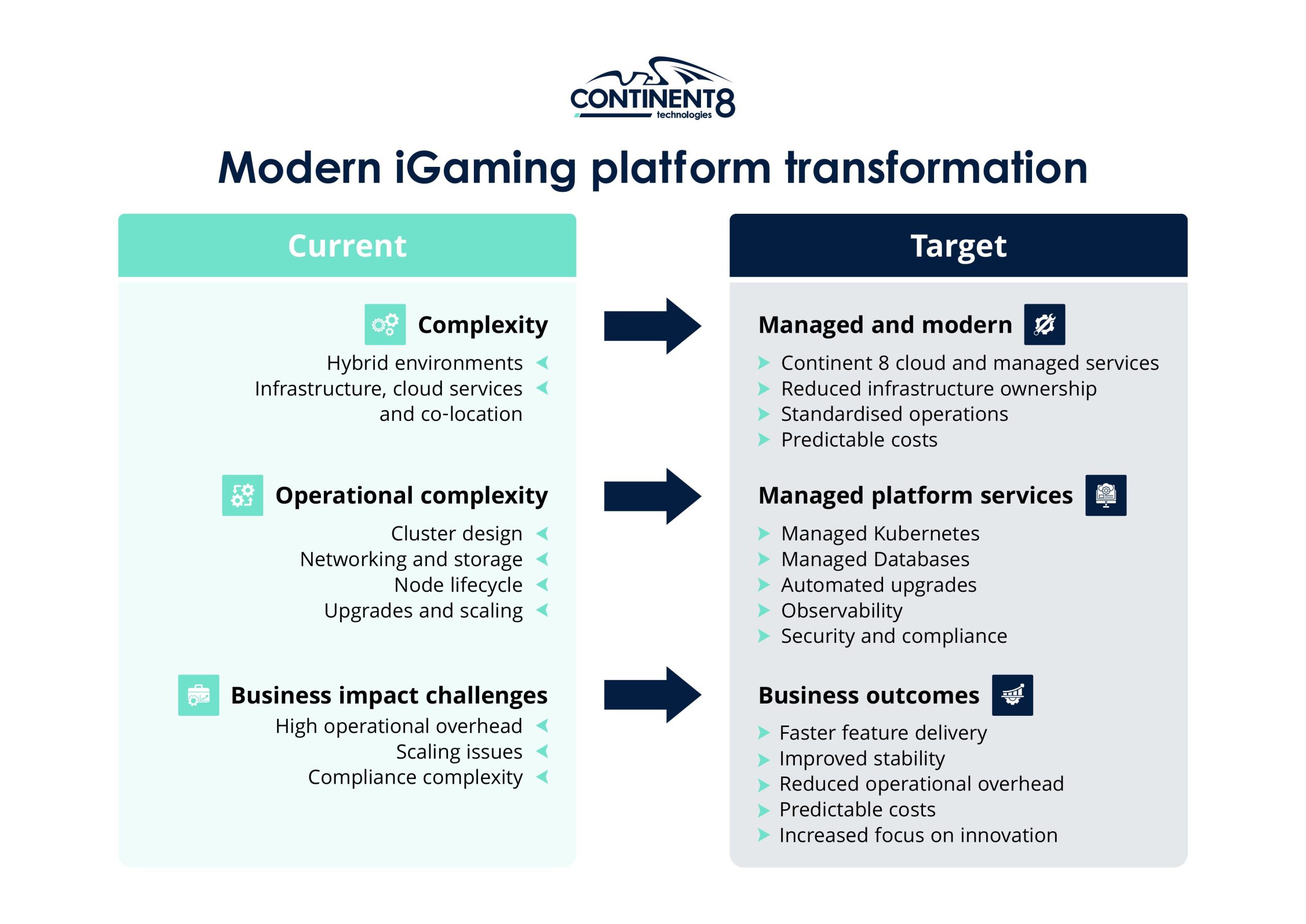
Continent 8 cloud and managed services are designed for the realities of regulated iGaming and online sports betting. The aim is to help operators scale across private, multi-tenant, Kubernetes, virtual machine, AWS Outposts, hybrid, and multi-cloud environments without asking internal teams to absorb every infrastructure, networking, database, security, compliance, and operations task themselves.
In this model, Continent 8 can support the operational foundations that sit beneath the application layer, including infrastructure lifecycle management, security and network segmentation, backup and disaster recovery, observability, integration with hyperscale cloud services, and 24/7 operations.
Managed Kubernetes can reduce the day-to-day effort involved in cluster provisioning, configuration, control plane and node lifecycle management, Kubernetes and operating system upgrades, availability, and scaling integration.
Managed database services can reduce recurring operational work around patching, version upgrades, backup validation, recovery testing, replication, failover management, and audit readiness.
The result is a more practical path to modernisation. Operators can retain control over their applications and business logic while foundational services are operated using consistent, repeatable practices designed for regulated, high-demand environments.
For a live betting operator, operational confidence means being ready for sudden spikes while odds, transactions, and customer interactions are moving in real time. The infrastructure must be scaled, but it must also remain observable, secure, and resilient throughout the event.
For an operator launching in a new regulated market, the pressure is different. Data residency, segmentation, logging, access controls, and audit evidence need to be considered from the start. A consistent managed model helps create repeatable foundations, so market expansion does not require a complete operational rebuild each time.
For a casino or sportsbook preparing for a major campaign, the priority is readiness. Compute capacity, database resilience, backup validation, monitoring, and incident response must all be in place before player activity peaks. Reducing the operational heavy lifting gives engineering teams more time to focus on product performance and player experience.
When infrastructure modernisation is paired with an operating model designed for scale, the value becomes more concrete. Features can move faster because teams are not waiting for every foundational task. Platforms become more resilient because lifecycle management, observability, and recovery processes are handled consistently. Compliance becomes easier to demonstrate because controls are designed into the operating model rather than added after the fact.
Costs also become easier to manage because capacity, services, and responsibilities are aligned to platform usage and business growth. Most importantly, teams gain clarity. They know what they own, what their partner operates, and how both sides work together to protect uptime, performance, compliance, and customer experience.
This focus on service quality is reflected in customer outcomes too, with a 2026 NPS score of 71 reinforcing the value of Continent 8’s managed services model that supports reliability, responsiveness, and trust.
Modern iGaming platforms do not just require modern technology. They require a smarter way to operate it – one that helps operators simplify complexity before it slows innovation, growth, or the player experience.
If you are evaluating how to scale your platform more efficiently, reduce operational overhead, or prepare for growth across regulated markets, Continent 8 can help you explore the right approach. Speak to our team at sales@continent8.com to build a more resilient, scalable, and manageable foundation for your next phase of growth.
Why iGaming operators and sportsbooks should treat networking infrastructure as a revenue engine (not just infrastructure).
After a long four-year wait, the FIFA World Cup is back – and this one is a monster. FIFA World Cup 2026 will be the largest tournament ever, featuring 48 teams and 104 fixtures, running from 11 June to 19 July.
For sportsbooks and iGaming operators, that schedule isn’t just exciting – it’s a traffic forecast. World Cup season compresses peaks into tight windows: match starts, halftime surges, late goals, VAR drama, stoppage time, and knockouts. These moments produce short, intense betting spikes where latency, availability, and security directly affect conversion, player trust, and margins.
As a managed IT service provider focused on networking, specialising in the iGaming sector, here’s the core truth we see every time a global event hits:
Your platform doesn’t “run on the cloud.” It runs on the network path between the player and your service.
Over the last four years, networking has evolved from “pipes and ports” to a performance and security fabric spanning edge, cloud, and identity.
Why it matters for iGaming: these advances shift the goal from “keep the WAN up” to “optimise experience under load, under attack, and under regulatory constraints.”
From 2022 onward, the product playbook moved aggressively toward real-time, high-frequency engagement:
1) Live betting became the center of gravity
Operators doubled down on in-play experiences where odds update constantly, and settlement must be fast. That model demands low jitter, fast market data, predictable latency, and a trusted, secure iGaming infrastructure partner.
2) Microbetting and “fast markets” pushed latency requirements into the sub-second zone
Trade coverage of microbetting repeatedly highlights low latency as a foundational requirement – a small delay can misalign markets with real-world events and break trust.
3) A more complex ecosystem: more vendors, more APIs, more paths to fail
Modern sportsbooks are assembled from components (streaming/CDNs, risk engines, KYC/AML, payments, fraud, personalisation and sports data feeds). Each added dependency increases the need for network segmentation, resilient routing, and end-to-end observability.
Bottom line: Since 2022, sportsbooks have increasingly become real-time transaction platforms. And real-time platforms live or die on networking.

Remember Paul the Octopus, the 2010 World Cup “oracle” who predicted match outcomes by choosing between flag-labeled boxes? CNN documented how the method worked and how Paul became a phenomenon. Paul’s overall record is often summarised as 12 correct predictions out of 14 (~85.7%).
Will 2026 bring a new animal oracle? Maybe. But the only “oracle” sportsbooks should rely on is better: network telemetry (latency, loss, jitter, and availability) – because those predictions are actionable.
This is the uncomfortable part: the betting window is time-bound. If a user can’t place a bet when the moment happens, they don’t “come back later.” The moment is gone – and so is the revenue opportunity.
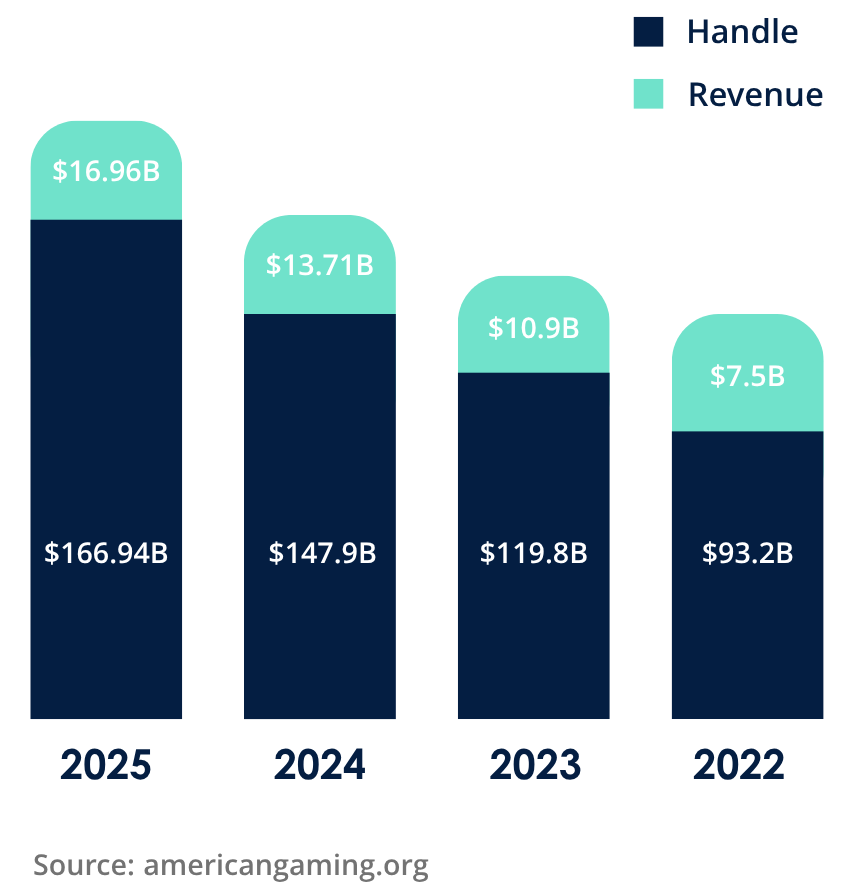
To ground that in real numbers, here’s a look at US sports betting performance over the last four years:
Real-world US sports betting stats (AGA)
Now translate that into downtime risk:
In other words: downtime isn’t just an IT incident – it’s a commercial event.
If we had to summarise a World Cup networking plan in one sentence: Build for peak, defend for attack, and operate for recovery.
The 5 pillars we design around
World Cup 2026 will deliver 104 matches worth of demand shocks, and the operators who win won’t just have better odds or better promos – they’ll have better uptime, better latency, and better recovery.
The last four years prove why: US sports betting handle and revenue have climbed dramatically from 2022 through 2025.
As the market grows, the cost of downtime grows with it – and the network becomes the invisible line between “player excitement” and “player churn.” Are you ready to handle the traffic?
Continent 8 is a global iGaming network service provider, learn more about our trusted solutions here or contact the team via sales@continent8.com
In a recent interview with G3 Magazine, Justin Cosnett, Chief Product Officer at Continent 8 Technologies, shared his insights on how major global sporting events are reshaping infrastructure demands across the betting industry.

The world’s biggest sporting events are no longer just moments-they are sustained digital stress tests for the global betting ecosystem.
Traditionally, operators prepared for short bursts of activity. A spike. A surge. A single, intense window.
But that model is rapidly becoming outdated.
The 2026 Super Bowl- and the upcoming FIFA World Cup-are reshaping how we think about infrastructure entirely. These events are not just about scale; they are about duration, distribution and resilience under constant pressure.
The Super Bowl has long been viewed as the ultimate peak event for sports betting. But even here, patterns are evolving.
Traffic no longer simply builds towards kick-off-it extends before, during and after. The operational window has widened, and so too have expectations placed on infrastructure.
And then comes the World Cup.
Unlike the Super Bowl, the World Cup is:
Rather than a single spike, it creates continuous, rolling demand across regions.
This is where the true challenge begins.
Scaling for a single peak is one thing. Designing for sustained, distributed engagement is quite another.
Operators must now rethink:
One critical takeaway is clear:
Infrastructure strain is driven by user volume and concurrency-not by individual high-value bets.
It’s not a handful of large wagers that push systems to their limits- it’s millions of users interacting simultaneously across markets.
Cloud adoption has transformed the industry- but it is not a cure-all.
Simply relying on hyperscale cloud providers does not guarantee resilience.
Instead, operators are increasingly adopting hybrid architectures, combining:
The objective is straightforward:
As Justin highlights, genuine resilience is achieved through careful design and planning-not technology alone.
As global sporting events grow in scale and complexity, infrastructure must evolve accordingly.
This means:
Because the next generation of betting moments will not just test systems over a few hours-they will test them continuously, worldwide and without pause.
For a deeper dive into Justin Cosnett’s perspective and Continent 8’s approach to managing global event infrastructure, read the full article in G3 Magazine: Read here