Why iGaming operators and sportsbooks should treat networking infrastructure as a revenue engine (not just infrastructure).
After a long four-year wait, the FIFA World Cup is back – and this one is a monster. FIFA World Cup 2026 will be the largest tournament ever, featuring 48 teams and 104 fixtures, running from 11 June to 19 July.
For sportsbooks and iGaming operators, that schedule isn’t just exciting – it’s a traffic forecast. World Cup season compresses peaks into tight windows: match starts, halftime surges, late goals, VAR drama, stoppage time, and knockouts. These moments produce short, intense betting spikes where latency, availability, and security directly affect conversion, player trust, and margins.
As a managed IT service provider focused on networking, specialising in the iGaming sector, here’s the core truth we see every time a global event hits:
Your platform doesn’t “run on the cloud.” It runs on the network path between the player and your service.
In 2026, “Networking” means more than bandwidth
Over the last four years, networking has evolved from “pipes and ports” to a performance and security fabric spanning edge, cloud, and identity.
What’s changed since 2022? (A quick networking evolution)
- HTTP/3 and QUIC matured into mainstream delivery tech. HTTP/3 was standardised in June 2022 (RFC 9114) and runs over QUIC (RFC 9000), improving behaviour under packet loss and enabling faster connection setup.
- Real adoption followed standards. Cloudflare measured continued growth in HTTP/3 usage across browser traffic after the RFC’s publication.
- Enterprise Wi‑Fi expanded into the 6 GHz band (Wi‑Fi 6E). The Wi‑Fi Alliance highlights how opening 6 GHz increases capacity and reduces congestion – a big deal for dense environments and low-latency needs.
- SASE became the default “secure networking” conversation. Gartner’s SASE category definition emphasizes converged network and security-as-a-service (e.g., SD‑WAN + secure access) regardless of user location.
Why it matters for iGaming: these advances shift the goal from “keep the WAN up” to “optimise experience under load, under attack, and under regulatory constraints.”
Sports betting platforms have changed since 2022 (and Networking had to keep up)
From 2022 onward, the product playbook moved aggressively toward real-time, high-frequency engagement:
1) Live betting became the center of gravity
Operators doubled down on in-play experiences where odds update constantly, and settlement must be fast. That model demands low jitter, fast market data, predictable latency, and a trusted, secure iGaming infrastructure partner.
2) Microbetting and “fast markets” pushed latency requirements into the sub-second zone
Trade coverage of microbetting repeatedly highlights low latency as a foundational requirement – a small delay can misalign markets with real-world events and break trust.
3) A more complex ecosystem: more vendors, more APIs, more paths to fail
Modern sportsbooks are assembled from components (streaming/CDNs, risk engines, KYC/AML, payments, fraud, personalisation and sports data feeds). Each added dependency increases the need for network segmentation, resilient routing, and end-to-end observability.
Bottom line: Since 2022, sportsbooks have increasingly become real-time transaction platforms. And real-time platforms live or die on networking.
Fun fact: Will 2026 produce an “Animal Oracle” to beat Paul the octopus? 🐙

Remember Paul the Octopus, the 2010 World Cup “oracle” who predicted match outcomes by choosing between flag-labeled boxes? CNN documented how the method worked and how Paul became a phenomenon. Paul’s overall record is often summarised as 12 correct predictions out of 14 (~85.7%).
Will 2026 bring a new animal oracle? Maybe. But the only “oracle” sportsbooks should rely on is better: network telemetry (latency, loss, jitter, and availability) – because those predictions are actionable.
Why network downtime is still one of the biggest revenue risks in sports betting
This is the uncomfortable part: the betting window is time-bound. If a user can’t place a bet when the moment happens, they don’t “come back later.” The moment is gone – and so is the revenue opportunity.
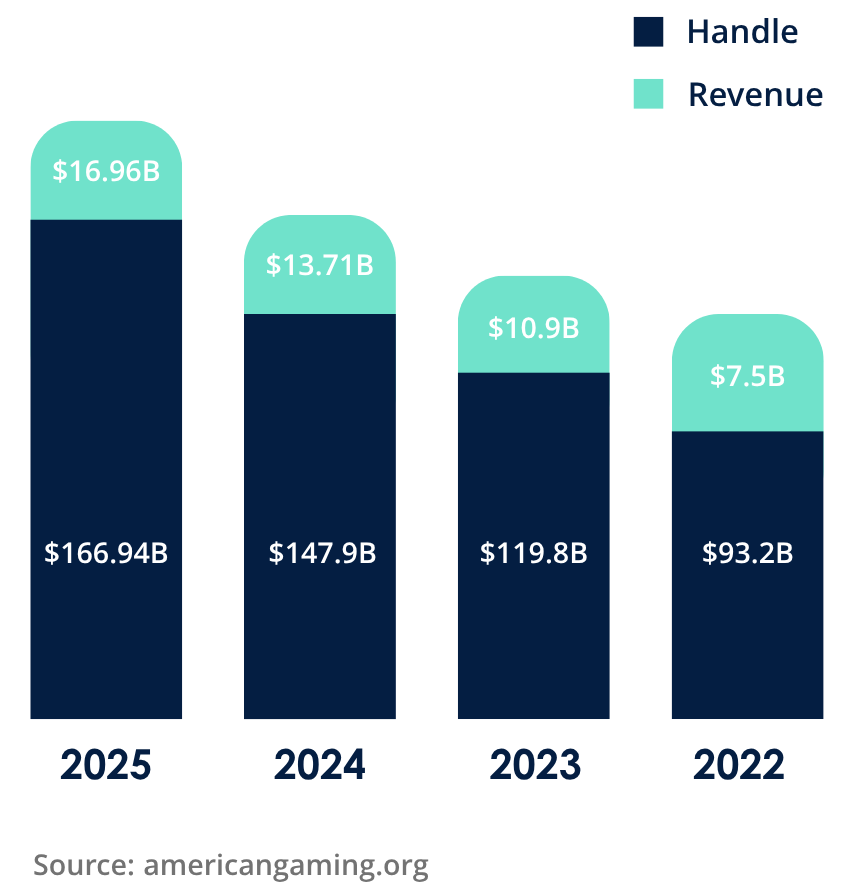
To ground that in real numbers, here’s a look at US sports betting performance over the last four years:
Real-world US sports betting stats (AGA)
Now translate that into downtime risk:
- Using 2025 revenue ($16.96B/year), the average revenue rate is roughly $1.94M/hour (simple division: 16.96B ÷ 365 ÷ 24).
- During World Cup peaks, traffic is not “average.” It clusters around match times. That means a 30-minute outage during a major fixture can cost far more than the daily average suggests – plus reputational damage, customer support load, and churn.
In other words: downtime isn’t just an IT incident – it’s a commercial event.
What “World Cup-ready networking” looks like
If we had to summarise a World Cup networking plan in one sentence: Build for peak, defend for attack, and operate for recovery.
The 5 pillars we design around
- Low‑latency cloud networking for iGaming
Use edge routing, optimised cloud interconnects, and protocol modernisation (e.g., HTTP/3 where appropriate) to reduce handshake cost and improve loss tolerance. - iGaming infrastructure resilience
Redundant circuits, active-active routing, tested failover, managed peering, and segmented blast-radius boundaries so one failure doesn’t flatten the whole platform. - DDoS protection for sportsbooks
Traffic spikes attract attackers. Edge protection and rate controls are not “nice to have” during marquee events. - Zero Trust sports betting networks
Modern access must follow user/device/app context, not physical location – consistent with SASE principles. - Network observability and response for iGaming
Latency, packet loss, jitter, DNS performance, API dependency maps – all tracked in a way that answers: “Is the player able to bet right now?”
The World Cup is a network event (whether you like it or not)
World Cup 2026 will deliver 104 matches worth of demand shocks, and the operators who win won’t just have better odds or better promos – they’ll have better uptime, better latency, and better recovery.
The last four years prove why: US sports betting handle and revenue have climbed dramatically from 2022 through 2025.
As the market grows, the cost of downtime grows with it – and the network becomes the invisible line between “player excitement” and “player churn.” Are you ready to handle the traffic?
Continent 8 is a global iGaming network service provider, learn more about our trusted solutions here or contact the team via sales@continent8.com